
 Other Briefings
Understanding How Vietnam's Middle Class Is Reshaping Consumer Spending
Vietnam aspires to attain upper-middle-income status by 2030 and to achieve high-income country status by 2050. The middle class in Vietnam is expected to expand to 26 percent of the population by 2026, up from 13 percent (approximately 13 million people) in 2023, creating significant opportunities for businesses.
Key takeaways
- Vietnam's consumer market is entering a new growth phase, supported by sustained economic expansion, rising incomes, and an expanding middle class.
- The middle class is projected to reach 26 percent of the population by 2026, creating a larger consumer base with greater purchasing power and demand for higher-value products and services.
- Consumer spending is becoming more sophisticated. While price remains the primary purchasing factor, consumers increasingly prioritise quality, convenience, health, sustainability, and trusted brands.
Vietnam has officially been reclassified by the World Bank as an upper-middle-income economy, marking a significant milestone in its economic development. The upgrade follows an increase in gross national income (GNI) per capita from US$4,490 in 2024 to US$4,970 in 2025, driven by sustained economic growth and strong export performance.
The new classification reflects Vietnam's improving purchasing power and expanding consumer market. Coupled with rising household incomes and a growing middle class, it reinforces the country's long-term potential for consumer-facing industries.
Economic trajectory of Vietnam

Vietnam’s economic growth remains on a robust trajectory as the country’s gross domestic product (GDP) grew 8.18 percent in H1 2026.
Vietnam’s ascendance in the global supply chain has been pivotal to its economic growth, driven by its manufacturing and export sectors. From 2012 to 2022, Vietnam’s exports expanded at an average annual rate of 12 percent, significantly outpacing the global average growth rate. The momentum continues as the country’s export turnover reached nearly US$266.5 billion in the first half of 2026, an increase of 21 percent year on year, according to the General Department of Customs.
Major multinational corporations, such as Samsung, Google, Microsoft, Apple, Nike, and Adidas, among others, have increasingly integrated Vietnam into their supply chains as part of diversified strategies like “China plus one.”
Foreign direct investment (FDI) into Vietnam continues to exhibit robust growth, reaching a total registered capital of US$34.65 billion by the end of June 2026, up 61 percent from a year earlier. While the number of newly approved projects edged up only 1.3 percent, newly registered capital jumped 87.2 percent to US$17.39 billion.
Vietnam middle-class consumption habits
Rising incomes support consumer spending
According to the General Statistics Office (GSO), the average monthly income of Vietnamese workers reached VND 9.0 million (approximately US$344) in the first half of 2026, up VND 717,000 (8.7 percent) from the same period in 2025. Although average income in Q2 2026 eased slightly from the previous quarter, it remained significantly higher than a year earlier.
The sustained rise in incomes reflects improving purchasing power and a growing capacity for discretionary spending, supporting demand across sectors such as retail, consumer goods, healthcare, education, and leisure. This trend is reinforced by Vietnam's expanding middle class and broader transition to an upper-middle-income economy, reflecting sustained economic growth and rising living standards.
Demographic trends further enhance this outlook. With a population approaching 102 million and a projected median age of 33.9 in 2026, Vietnam remains one of Asia's youngest large consumer markets. Its relatively youthful, increasingly urbanised, and digitally connected population is driving the adoption of e-commerce, digital payments, and premium consumer products, making the country an attractive destination for businesses targeting long-term consumption growth.
Vietnam's expanding middle class underpins long-term consumer demand
Vietnam's consumer market is being supported by a steadily expanding middle class with rising purchasing power. According to a 2026 Q&Me survey covering more than 14,000 respondents, average household income reached VND 21.9 million (US$831) per month, up from VND 21.3 million in 2025, reflecting continued income growth rather than a short-term spike.
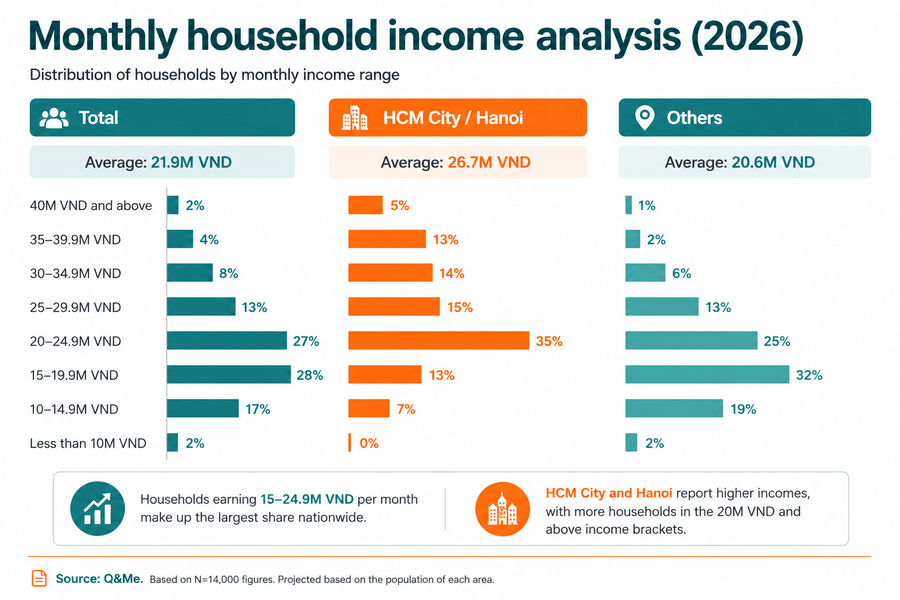
Several demographic trends highlight the evolution of Vietnam's middle-income segment:
- Middle-income households are becoming the dominant consumer group. The largest income bracket nationwide is households earning VND 15–24.9 million per month, accounting for more than half of all households surveyed, while the VND 20–30 million segment continues to expand.
- Income remains concentrated in major cities. Average monthly household income reached VND 27.5 million in Ho Chi Minh City and VND 25.9 million in Hanoi, compared with the national average of VND 21.9 million, indicating that the country's largest urban centres remain the primary markets for premium goods and services.
- Affluent consumer segments are deepening. Ho Chi Minh City has the highest concentration of households earning above VND 30 million per month, while Hanoi's income distribution is centred on the VND 20–29.9 million range, suggesting growing demand for higher-value products and experiences.
What are Vietnamese consumers spending on?
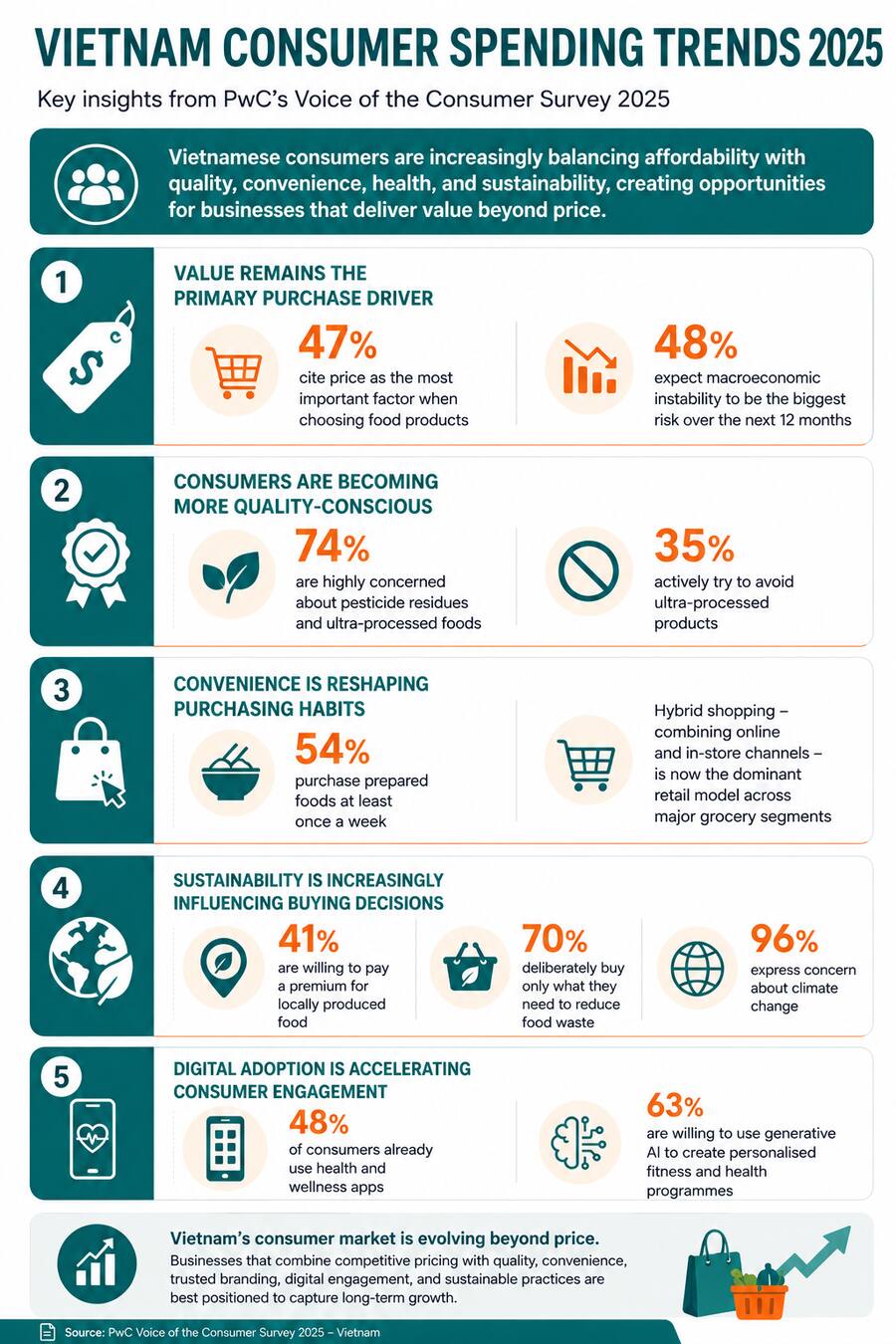
Vietnam's rising incomes are translating into stronger consumer demand, but purchasing behaviour is becoming more discerning. According to PwC's Voice of the Consumer Survey 2025, consumers are increasingly balancing affordability with quality, convenience, health, and sustainability, creating opportunities for businesses that deliver value beyond price.
Key consumer spending trends include:
- Value remains the primary purchase driver, with 47 percent of Vietnamese consumers cite price as the most important factor when choosing food products.
- Consumers are becoming more quality-conscious, as 74 percent are highly concerned about pesticide residues and ultra-processed foods, and 35 percent actively try to avoid ultra-processed products.
- Convenience is reshaping purchasing habits. While 54 percent of surveyed consumers purchase prepared foods at least once a week, hybrid shopping has become the dominant retail model across major grocery segments.
- Sustainability is increasingly influencing buying decisions as most consumers deliberately buy only what they need to reduce food waste and express concern about climate change.
- Digital adoption is accelerating consumer engagement, highlighting growing openness to AI-enabled consumer services and personalised digital experiences.
Together, these trends suggest Vietnam's consumer market is moving beyond price-led competition. As incomes and the middle class continue to expand, businesses that combine competitive pricing with quality, convenience, trusted branding, and digital engagement are likely to be best positioned for long-term growth.
Opportunities for foreign businesses in Vietnam
Vietnam's expanding middle class, rising incomes, and increasingly sophisticated consumer preferences are creating new opportunities for foreign brands. To capture long-term growth, businesses should consider:
- Target the growing middle class with value-for-money products that balance affordability and quality.
- Expand premium offerings, particularly in food and beverage, beauty, healthcare, and lifestyle products, as consumers increasingly spend on quality, health, and convenience.
- Adopt an omnichannel strategy by integrating e-commerce with physical retail to meet evolving shopping habits.
- Look beyond major cities, as rising incomes in tier-2 and tier-3 markets are broadening consumer demand.
- Emphasise health, sustainability, and trusted branding, as these factors are becoming increasingly important alongside price.
As Vietnam transitions to an upper-middle-income economy, businesses that combine competitive pricing with strong branding, digital engagement, and products tailored to local preferences will be best positioned to succeed.
[faq title="FAQ - Vietnam’s Middle Class – Business Essentials"]
Q1: How large is Vietnam's middle class?
Vietnam's middle class is expanding rapidly as incomes continue to rise. It is projected to account for 26 percent of the population by 2026, up from 13 percent (around 13 million people) in 2023. This growing consumer segment is expected to drive long-term demand for higher-value goods and services as Vietnam advances towards its goal of becoming an upper-middle-income economy by 2030.
Q2: What are the key spending trends among Vietnamese consumers?
Vietnamese consumers are becoming more discerning in their purchasing decisions. While price remains the primary purchase driver, consumers increasingly seek products that combine affordability with quality, convenience, health, and sustainability. Omnichannel shopping and digital engagement are also becoming integral to the consumer journey.
Q3: Which consumer segments offer the greatest market potential?
The VND 15–24.9 million monthly household income bracket is now Vietnam's largest consumer segment, while higher-income households continue to grow in Ho Chi Minh City and Hanoi. At the same time, rising incomes in tier-2 and tier-3 cities are creating new opportunities as purchasing power expands beyond the country's largest metropolitan areas.
Q4: Which sectors offer the strongest opportunities for foreign businesses?
Rising incomes and an expanding middle class are supporting demand across consumer goods, food and beverage, beauty and personal care, healthcare, education, retail, and lifestyle services. Businesses that deliver value for money while differentiating through quality, innovation, and trusted branding are well positioned to capture market growth.
Q5: What strategies should companies adopt to succeed in Vietnam's consumer market?
Businesses should develop products that balance affordability and premium quality, strengthen omnichannel distribution, expand into emerging urban markets, and align offerings with consumers' growing focus on health, convenience, sustainability, and personalised experiences.
[/faq]
Ready to Tap into Vietnam’s Middle-Class Growth Story?
As Vietnam’s consumer landscape evolves, businesses that act early will capture the most value. Our experts at Dezan Shira & Associates help foreign companies navigate Vietnam’s regulatory, tax, and market-entry landscape with:
- Consumer market analysis tailored to your industry
- Market entry and expansion strategy across Vietnam’s cities and provinces
- Partner identification and business matchmaking
- Cross-border business structuring to scale in ASEAN
Contact us today to discuss your entry strategy or request a customized Vietnam market opportunity report at: Vietnam@dezshira.com
This article was originally published on 5 July 2024. It was last updated on 28 July 2026.
This article first appeared on Vietnam Briefing, our sister platform.

